
Guide
The Noise Your Garage Door Is Making Isn't Random
A grinding, popping, or scraping door in Atlanta usually traces back to 1960s-70s hardware and cold-morning swings. Here's what each sound tells you before you call.
Local detail
Leaving It Alone
A garage door that's gotten louder over the past few months in Grant Park, West End, or any of the older pockets around Atlanta isn't breaking in gradually - it's telling you something specific broke a little more this week than last. Most homeowners let it ride because the door still opens. That's the wrong test. The right test is whether the sound has changed shape: a squeak that turns into a bang, or a hum that turns into a grind.
Here's the honest limit: I can't tell you exactly which part from a description over the phone. A popping sound could be a loose hinge or a spring three turns from letting go. What I can tell you is that in a city where most garage doors are running original or first-replacement hardware from a 1960s-70s build era, waiting rarely buys you anything. The part doesn't heal. It wears until it lets go, usually on the coldest morning of the month when you're already late.
If the door is quiet and smooth, leave it alone. If it's started making a sound it didn't make a year ago, that's the one thing worth acting on before it becomes an emergency call instead of a scheduled one.
The area
What Local Conditions Do
Atlanta sits in a cold-moderate climate band - not brutal winters, but enough freeze-thaw mornings each year to matter. Steel track and springs contract slightly when the temperature drops, and on a door with any existing wear, that contraction is what turns a silent gap into an audible one. This is why the loudest complaints tend to cluster in the colder stretches of the year rather than summer.
It isn't the cold causing damage on its own. It's the cold exposing damage that was already there. A roller with a flat spot rolls quietly in July and clunks in January because the metal around it has tightened up just enough to catch. Same part, same wear, different sound - because the conditions changed, not the door.
This matters more here than it would in a warmer market, because a lot of the housing stock in the Atlanta service area - from Grove Park to Buckhead to the Old Fourth Ward - was built well before doors were engineered with today's cold-cycle tolerances in mind. Older hardware has less margin. The seasonal swing that a newer door shrugs off is the same swing that makes an older one announce itself.
What we find
What Is Going On
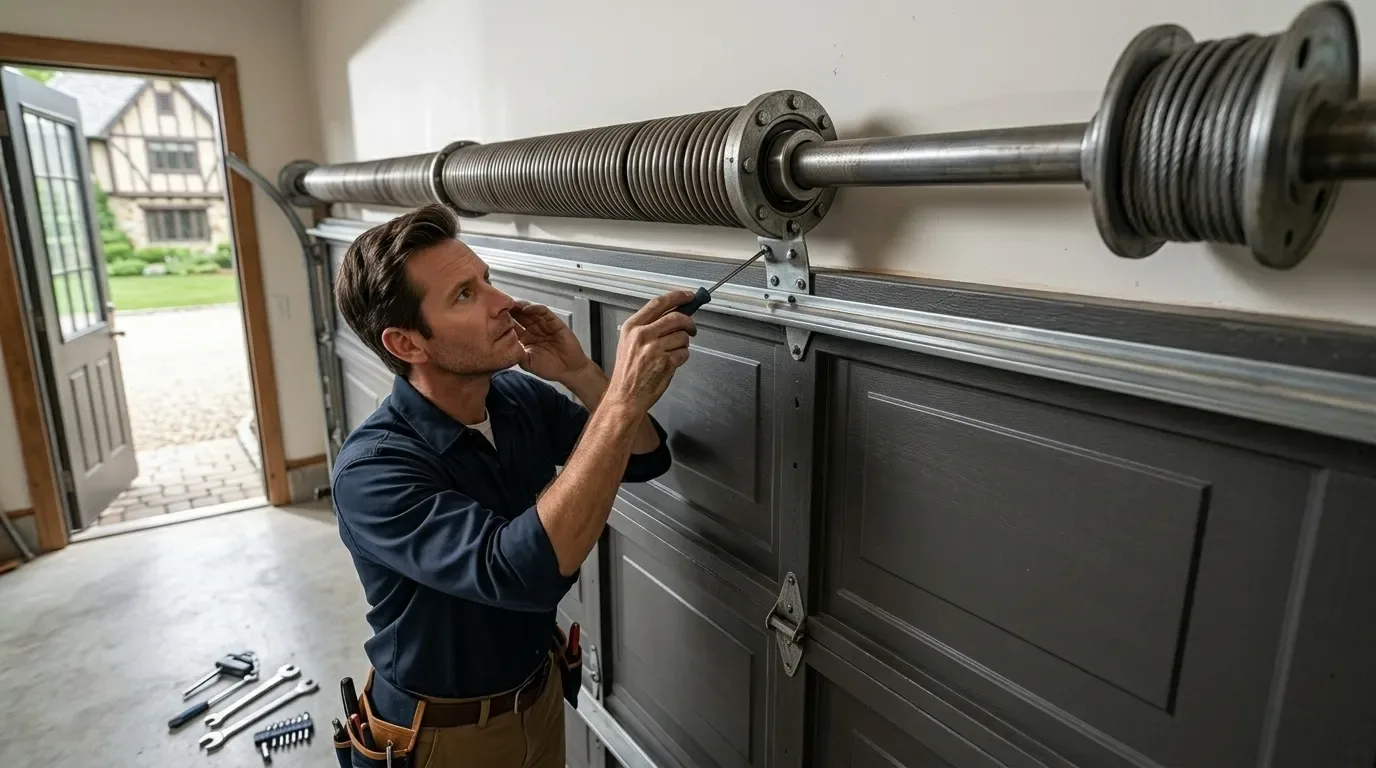
Across the roughly 36 named areas in the Atlanta service footprint, housing runs from 1951 up through 2004, with the median landing around 1978. That means a lot of doors out there are original torsion spring setups, or a first replacement installed decades ago, carrying rollers and cables well past their rated cycle life. A spring rated for 10,000 cycles doesn't care how careful you've been - cycle count is cycle count, and a door installed when a house was built in the late 1970s has had a long time to use them up.
A rhythmic thump on the way up usually points to a flat-spotted roller. A sharp bang, especially followed by the door refusing to move, points to a spring. A steady grind that gets worse as the door travels further points to track that's drifted out of alignment, which happens more often in older houses where the frame itself has settled over the decades.
Newer construction mixed into the same neighborhoods - closer to the 2004 end of the range - tends to run quieter longer, simply because the hardware hasn't had 40-plus years to fatigue. Same city, different noise profile, and the difference is the install date, not the address.
How we work
The Common Mistake
The mistake I see most in Atlanta is spraying lubricant on a noise and calling it fixed. It quiets things down for a week, sometimes a month, and then the sound comes back louder because the underlying wear didn't go anywhere - it just got slippery. Lubricant is a real tool for a hinge or a track that's dry, not a fix for a spring losing tension or a roller with a worn bearing.
The second mistake is treating every noise as a full-replacement decision. A door built during Atlanta's mid-century boom, with solid panels and a straightforward torsion setup, is often worth repairing rather than tearing out - the housing stock median lands around 1978, and a lot of that hardware can be serviced part by part instead of replaced whole. Going straight to a new door when a spring swap would've done it is money that didn't need to leave the house.
The way to tell the difference is to describe the sound accurately: when it happens in the door's travel, whether it changed suddenly or crept up, and whether it's louder on cold mornings. That's usually enough for a straight answer over the phone about whether it's a small job or a bigger one.
Questions
Common questions
My garage door only makes noise on cold mornings - is that serious?
Often, yes, even though it sounds minor. Cold contracts the metal in track and springs just enough to expose wear that's silent the rest of the year. In Atlanta's cold-moderate climate, that seasonal creak is usually the earliest warning a part is close to failing, not a quirk to ignore.
Is a loud bang always a broken spring?
A sudden bang followed by the door refusing to move is the classic spring failure sound, especially on older torsion setups common in Atlanta's 1960s-70s housing stock. It can also be a cable snapping. Either way, stop using the door and don't try to force it open manually.
Why does my neighbor's newer house have a quieter door than mine?
Install date matters more than street. Housing across the Atlanta area ranges from 1951 to 2004, and hardware installed closer to the newer end simply hasn't had the decades of cycles that fatigue springs and rollers in the older stock.
Should I just replace the whole door if it's noisy?
Not usually. Most of the noises tied to Atlanta's older housing stock come from a specific worn part - a roller, a spring, a track alignment - that can be serviced without replacing the door itself. Full replacement makes sense when the panels or frame are damaged, not just noisy.
Ready when you are
Need a garage door sorted in Atlanta?
Atlanta Garage Door Pros repairs and installs garage doors, springs and openers in Atlanta, GA and the surrounding area.